For many school leaders, cybersecurity feels like an IT problem.
Until it isn't.
A cyberattack doesn't just impact servers, networks, or devices. It can disrupt classrooms, delay payroll, lock teachers out of critical systems, expose sensitive student information, and damage trust within the school community.
The reality is that schools of all sizes are becoming targets for cybercriminals. According to the U.S. Department of Education, school districts across the country are experiencing an average of five cyber incidents per week, making cybersecurity an increasingly important part of school operations and risk management.
The question is no longer whether schools should prepare for a cyber incident.
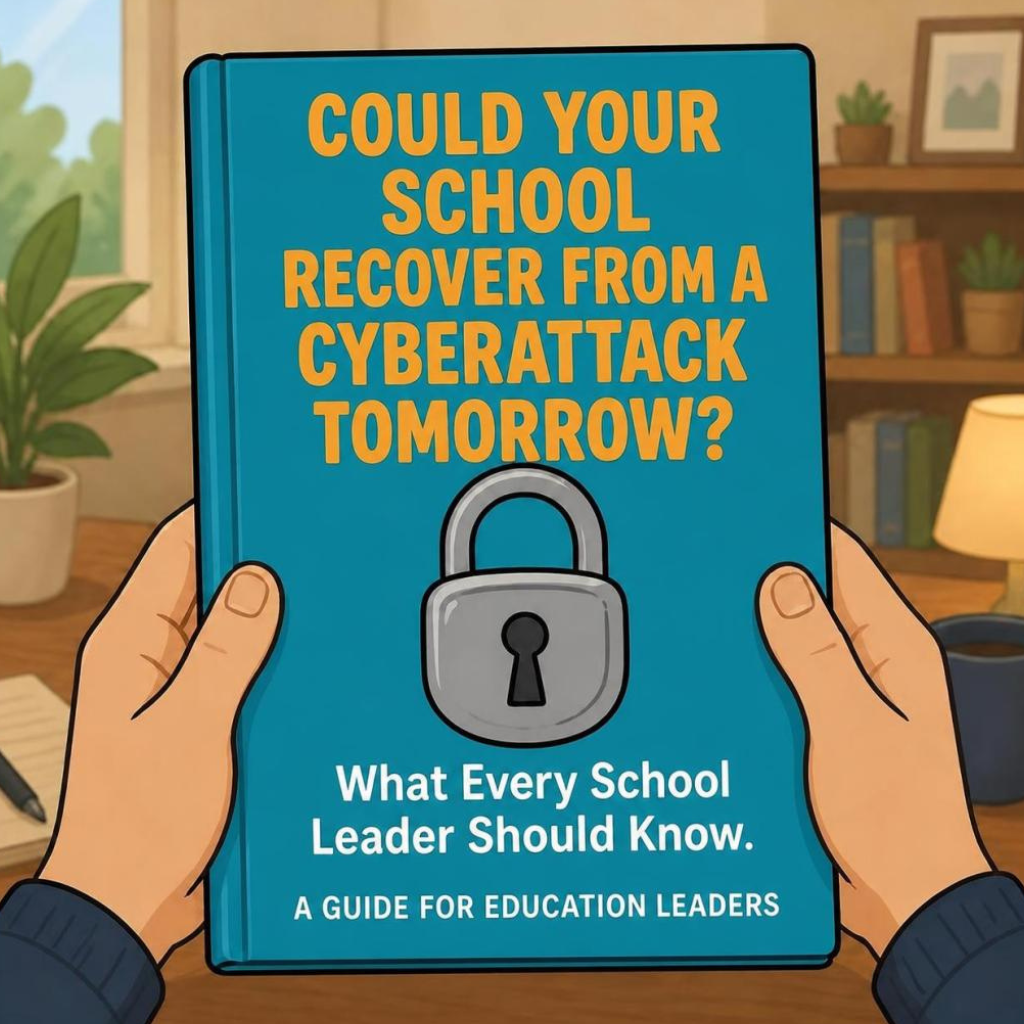
The question is whether your school could recover if one happened tomorrow.
Cyberattacks Affect More Than Technology
When most people hear the term cyberattack, they imagine hackers breaking into systems.
In reality, many cyber incidents begin with something much simpler.
A teacher clicks on a phishing email.
A weak password is compromised.
An outdated application is left unpatched.
An employee unknowingly shares information with a malicious actor.
The U.S. Department of Education identifies phishing emails and outdated software as two of the most common vulnerabilities cybercriminals exploit in K-12 schools.
What starts as a single mistake can quickly grow into a much larger problem.
Student records may become inaccessible.
Communication systems may go offline.
Financial information may be exposed.
Instructional time may be lost.
The impact reaches far beyond the technology department.
The Hidden Cost of a Cyber Incident
Many school leaders focus on the immediate technical challenges of a cyberattack.
However, the long-term consequences can be far more significant.
According to the U.S. Department of Education, cyber incidents can result in:
- Disruptions to teaching and learning
- Operational interruptions and manual processes
- Legal and insurance expenses
- Financial losses
- Loss of trust among parents, teachers, and the broader school community
Even schools with strong educational programs can face significant setbacks when critical systems become unavailable.
Recovery often requires far more time, effort, and resources than prevention.
What Would Happen If Your Systems Went Offline Today?
Consider the following questions:
Could your school access student records if your primary system became unavailable?
How quickly could staff continue operations if email stopped working?
Are backups regularly tested and verified?
Who would coordinate communications with parents and staff during an incident?
How long could your school function without access to its technology systems?
Many schools discover the answers to these questions only after an incident occurs.
The most resilient schools ask them before they have to.
Five Steps School Leaders Can Take Right Now
The good news is that improving cybersecurity does not always require a large technology budget.
Many of the most effective protections are practical, affordable, and straightforward to implement.
- Enable Multi-Factor Authentication
Passwords alone are no longer enough.
Multi-factor authentication adds an additional layer of security that significantly reduces the likelihood of unauthorized access.
This should be enabled for email accounts, financial systems, student information systems, and administrative accounts whenever possible.
- Keep Software Updated
Outdated applications remain one of the easiest entry points for cybercriminals.
Regular patching and software updates help close known vulnerabilities before they can be exploited.
- Train Staff to Recognize Threats
Technology alone cannot prevent every attack.
Regular cybersecurity awareness training helps teachers and staff identify suspicious emails, phishing attempts, and social engineering tactics before they become incidents.
- Verify Your Backup Strategy
Having backups is important.
Knowing they actually work is even more important.
Schools should routinely test backups and recovery procedures to ensure critical systems can be restored quickly when needed.
- Develop a Cyber Incident Response Plan
Every school has fire drills.
Every school should also have a cybersecurity response plan.
When roles, responsibilities, and communication procedures are clearly defined in advance, schools can respond more effectively and reduce disruption during an incident.
Cybersecurity Is a Leadership Issue
Technology teams play an important role in protecting school systems.
However, cybersecurity is no longer solely an IT responsibility.
It is a leadership responsibility.
School leaders make decisions about budgets, policies, training, risk management, vendor selection, and operational priorities. Each of these decisions contributes to a school's cybersecurity posture.
The strongest cybersecurity programs are built when leadership, administration, and technology teams work together toward a common goal: protecting students, staff, and learning.
Preparation Creates Confidence
No school can eliminate every risk.
But every school can become more resilient.
The schools that recover most successfully from cyber incidents are not necessarily the ones with the largest budgets or the newest technology. They are the schools that prepare in advance, establish clear processes, educate their staff, and regularly evaluate their risks.
Cybersecurity is ultimately about protecting your ability to fulfill your mission.
Because when technology is unavailable, teaching and learning are impacted.
When technology is protected, educators can focus on what matters most: helping students succeed.
How IT for Education Can Help
At IT for Education, we work exclusively with K-12 schools to help leaders strengthen cybersecurity, reduce risk, and build technology environments that support teaching and learning.
From cybersecurity assessments and staff awareness training to backup strategies, network security, and long-term technology planning, our team helps schools take a proactive approach to protecting their communities.
If your school would like to better understand its cybersecurity readiness, we would be happy to schedule a Technology Readiness Review and help identify opportunities to strengthen your defenses before an incident occurs.