
A few weeks into the year, most Catholic school leaders are asking a version of the same question: is our technology holding up? It is a fair question, but it is also the wrong one. “Ready” only tells you whether things work on the first morning. It says nothing about the twelve months that follow.
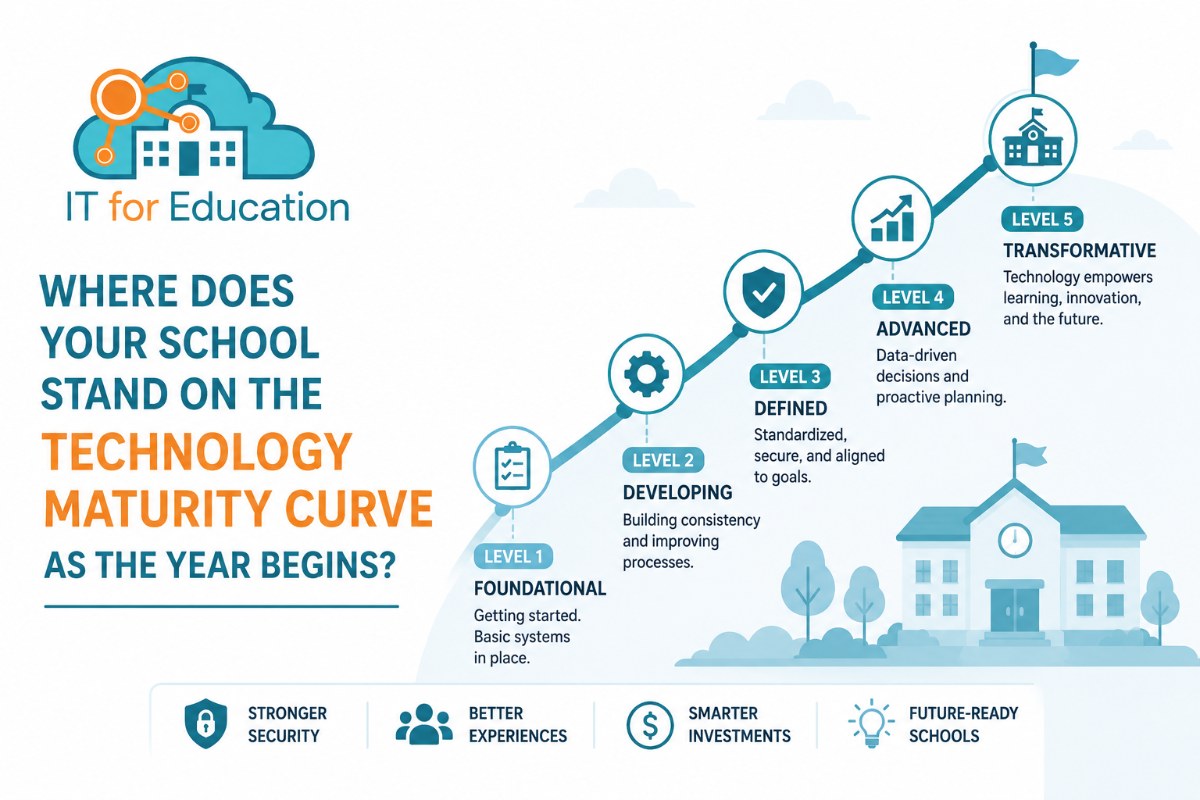
There is a more useful question, and it is one good stewards ask about every asset in their care: where does our technology honestly stand, and where is it headed? Technology in a school tends to sit on a curve. At one end is reactive: you fix what breaks, when it breaks, usually at the worst possible time. A step up is stable: the essentials mostly hold, but no one is looking ahead. Higher still is proactive: problems are caught and prevented before they interrupt a classroom. At the top is strategic: technology is planned years out and actively advances the school’s mission rather than merely supporting it.
For Catholic and Archdiocese schools, this curve carries particular weight. Many of your campuses have served families for decades, and that history often lives in the infrastructure: a server added one year, a network expanded the next, systems layered on by different hands across different eras. Each layer worked when it was installed. Together, without a plan holding them, they tend to settle at the reactive end of the curve: not because anyone chose that, but because no one was ever given the time or the mandate to look at the whole picture.
The internal weight of this is real. As a principal, president, or diocesan administrator, you are stewarding tuition dollars entrusted by families who expect them spent wisely, and you carry the trust of a community that has believed in your school for generations. Living at the reactive end means that trust is quietly exposed: one failure, one bad week, one emergency that families see. You did not take this role to become the person deciding, under pressure, whether an aging system can limp through another year.
Here is the deeper truth. Good stewardship is not only about keeping the lights on this year. It is about knowing where you stand and choosing, deliberately, to move forward. A school does not have to leap from reactive to strategic overnight. It only has to advance one level this year, and then hold that ground while it prepares for the next.
This is exactly the gap IT for Education exists to close. For more than 24 years, we have worked exclusively with K-12 schools, including Catholic and diocesan-affiliated schools across Florida, and we understand that you already wear enough hats. You should not have to become an IT expert to know where your school stands. As a recipient of the MSP Titans in Education Award, we help school leaders see their technology clearly and move up the curve on purpose.
Now that the year is underway, we recommend three steps:
Schedule a Discovery Meeting: we learn about your school’s goals, current technology environment, and where your systems honestly sit on the maturity curve today.
Assess and Build a Roadmap: we identify what is holding you at the reactive end, and build a multi-year plan, aligned to your budget and mission, to move you up one level at a time.
Support, Secure, and Strategically Guide: we proactively manage and monitor your environment year-round and revisit the plan as your campuses grow.
Schools that name where they stand now move through the year with a direction instead of a hope: fewer surprises, steadier budgets, and a technology environment that finally moves in step with the mission it serves.
There is still time this fall to trade “we fix it when it breaks” for a plan that moves you forward. Let’s find out where your school stands, and where it could be by this time next year.