Every fall, families walk your campus deciding whether your school is the right home for their child. They will never see your network closet or ask about your server. But they feel the results of your technology everywhere: in whether the tour runs smoothly, whether the classroom experience matches the promise, whether the school feels like a place that has its act together. In a competitive private-school market, that impression is not a small thing. It is part of how families decide.
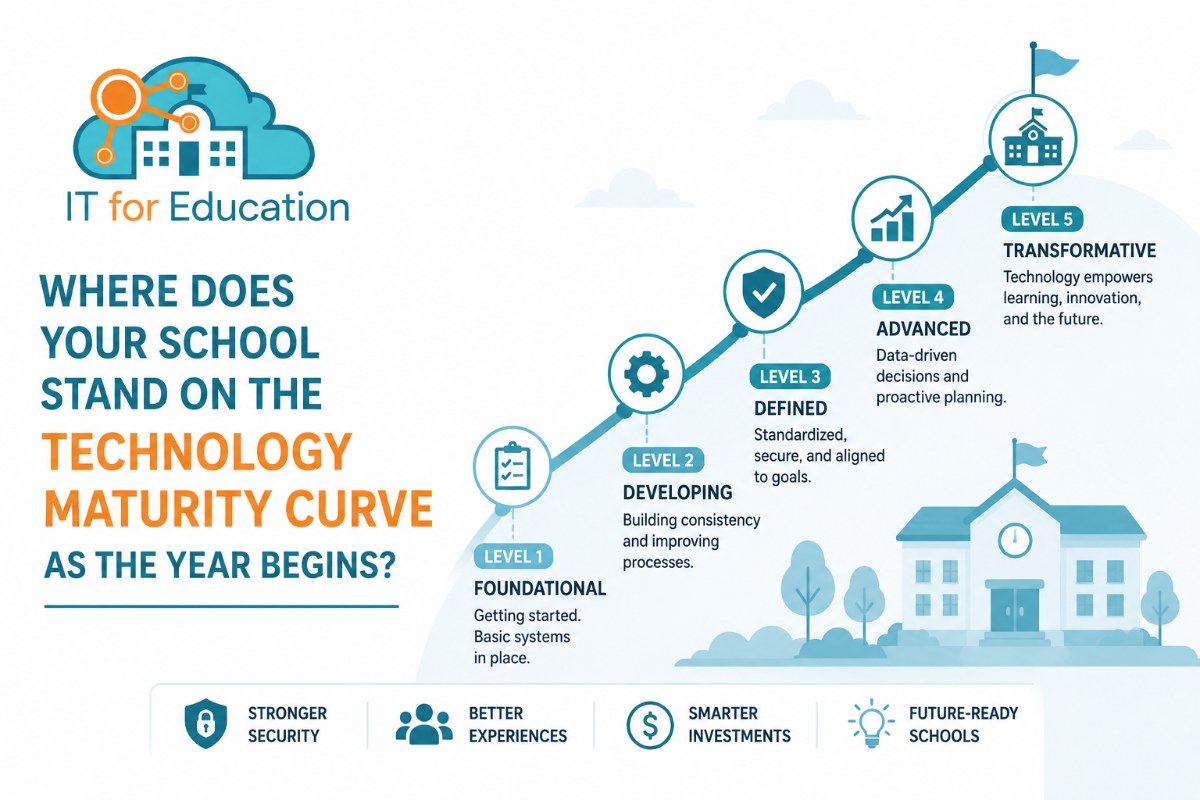
It helps to think of technology as sitting on a maturity curve. At the bottom is reactive: problems are fixed as they appear, usually in front of the wrong audience. A step up is stable: the basics hold, but no one is planning ahead. Higher is proactive: issues are caught before anyone notices them. At the top is strategic: technology is planned years out and quietly reinforces what makes your school distinctive. Families cannot name where you sit on this curve, but they can sense it.
For independent schools, the stakes are specific to who you are. A Montessori program has made intentional choices about how and when technology appears in a child’s day: mature technology honors those choices seamlessly, while reactive technology forces compromises no one wanted. A Jewish day school runs a dual curriculum with complexity most institutions never face: mature systems carry that load invisibly. A Christian academy wants technology that serves formation rather than distracts from it. In every case, your technology should protect and express your identity, not undermine it at the worst moment.
There is an internal weight here too. As a head of school, principal, or administrator, you are the guardian of a reputation built over years and a program that sets your school apart. When technology stumbles, during a tour, an admissions event, a parent’s first week, it does not read as a technical hiccup. It reads as a question about whether the school is well run. Carrying that worry, while also carrying everything else, is exhausting.
The deeper truth is philosophical. Your school exists to deliver a distinctive education and to earn the trust of families who chose you over every other option. It does not exist to troubleshoot technology or to gamble each fall on whether the systems will hold in front of prospective parents. Technology should be one of the quiet reasons families feel confident in you: never a reason for doubt.
This is the gap IT for Education exists to close. For more than 24 years, we have worked exclusively with K-12 schools, including Christian, Montessori, Jewish, and other independent schools across Florida, and we understand that your technology has to fit your mission, not the other way around. You should not have to become an IT expert to protect the reputation you have built. As a recipient of the MSP Titans in Education Award, we help independent schools climb the maturity curve so technology becomes a quiet advantage.
Now that the year is underway, we recommend three steps:
Schedule a Discovery Meeting: we learn about your school’s goals, your program’s distinctive needs, and where your technology honestly sits on the maturity curve today.
Assess and Build a Roadmap: we identify what is keeping you reactive, and build a plan, aligned to your budget and identity, to move you up the curve one level at a time.
Support, Secure, and Strategically Guide: we proactively manage and monitor your environment year-round so technology quietly reinforces what makes your school distinctive.
Schools that advance up the curve now present themselves to families the way they intend to: smooth tours, seamless classrooms, and a technology environment that reflects the excellence of the program it supports.
There is still time before enrollment season fills your calendar to trade reactive technology for a plan that protects your reputation. Let’s find out where your school stands, and where it could be by this time next year.