
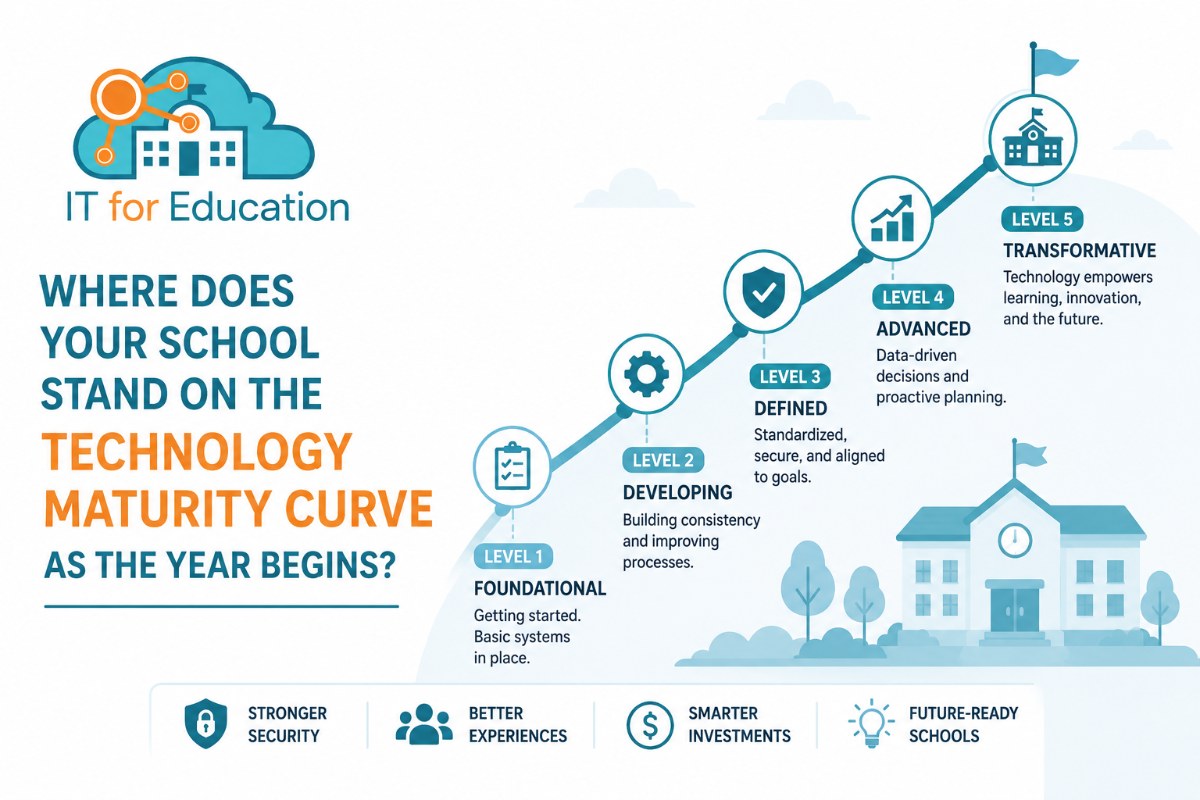
A few weeks into the new charter year, most leaders are focused on the immediate: enrollment counts, staffing, the daily rhythm of instruction. Technology usually enters the conversation only as a yes-or-no question: is it working? But your authorizer is asking something more demanding than whether your systems are on. They are measuring maturity: whether your school runs on documented, stable, well-managed operations, or whether it improvises when something breaks.
It helps to picture technology on a curve. At the bottom is reactive: you fix problems as they surface, often in a scramble. A step up is stable: the basics hold, but nobody is looking ahead. Higher is proactive: issues are caught before they reach a classroom or a report. At the top is strategic: technology is planned years out and supports growth on purpose. Authorizers reward schools that can demonstrate they are climbing this curve, because operational maturity is one of the clearest signals that a charter is being run responsibly.
The timing sharpens the point. Now that the year is underway, you are deep in a season of accountability: enrollment counts, state reporting, compliance checks, and the long runway toward renewal. Each of these depends on technology that works predictably and can be documented when someone asks. A reactive environment does not just risk a bad day; it risks producing exactly the kind of instability an authorizer is trained to notice.
There is an internal weight here too. Charter schools run lean by design, and on a small administrative team the person responsible for technology decisions is usually responsible for a dozen other things as well. When a system fails, you are the one improvising a fix while the rest of your work waits. Living at the reactive end of the curve is not just an operational risk: it is a personal one, and it quietly drains the energy you would rather spend on students and mission.
The deeper issue is philosophical. Your school exists to educate students and to prove, year after year, that the charter model works. It does not exist to troubleshoot technology or to explain to an authorizer why a system that should have been documented never was. Technology should make your accountability easier to demonstrate, not harder.
That is the gap IT for Education closes. For more than 24 years, we have worked exclusively with K-12 schools, including charter schools across Florida, and we understand the accountability you operate under. You should not have to become an IT expert to show an authorizer that your operations are mature and well-run. As a recipient of the MSP Titans in Education Award, we help lean charter teams climb the maturity curve without adding headcount.
As the year gets up to speed, we recommend three steps:
Schedule a Discovery Meeting: we learn about your school’s goals, your reporting and compliance calendar, and where your systems honestly sit on the maturity curve today.
Assess and Build a Roadmap: we identify what is keeping you reactive, and build a documented, cost-aware plan to advance one level at a time, sized to per-pupil realities.
Support, Secure, and Strategically Guide: we proactively manage and monitor your environment and keep the documentation current, so maturity is something you can show, not just claim.
Charter schools that climb the curve now can show an authorizer exactly how their operations are managed, documented systems, proactive oversight, and a plan for what comes next, instead of hoping nothing breaks during a review.
There is still time this fall to trade a reactive environment for a maturing one. Let’s find out where your school stands, and build the plan that moves it up.